|
MONDAY EDITION June 8th, 2026 |
 |
Home :: Archives :: Contact |
 |
OIL MARKET UPDATE - oil and oil stock traders - CLOSE STOPSClive Maund August 25th, 2005 Oil hit a target at an inner trendline that we had already delineated in the last Marketwatch Oil, but I was not fast enough and it slammed down during one trading session early last week. Because it has since recovered a good part of that 1-day loss, the damage is so far slight, however, the same cannot be said of the oil stock indices, which have recovered less of the sharp losses they suffered last week, following the failure of an upside breakout from a channel, and since the action in the stocks usually presages action in oil itself, stock bulls need to be careful right now. The 3-year chart for West Texas Light Crude shows that it is only short and medium-term traders who are likely to succumb to paranoia and nail-biting. This is a very bullish picture of a vigorous long-term uptrend that shows no signs of breaking down. However, short and intermediate-term traders are faced with a much greater challenge at this juncture. Crude is still showing significant net gains following the rally of the past few weeks that was predicted in the last update, but now we are in much more choppy waters where the outcome of the present contradictory indications is much more difficult to predict. 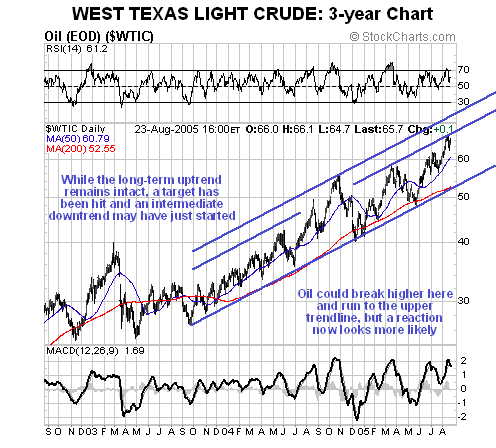 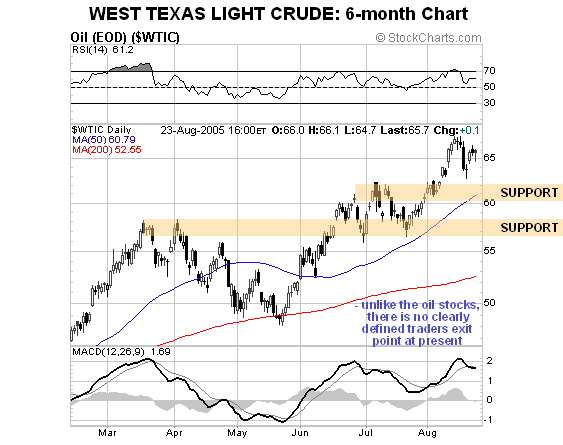 On the one hand, oil hit a target at the channel line shown, from which it recoiled abruptly, frequently a signal of a change in trend, particularly as the 50-day moving average has now run way ahead of the 200-day. Also, it is worth noting at this point that the past 2 intermediate uptrends ran for about 3 months, and were followed by reactions lasting about 2 months, and the current uptrend has run for about 10 weeks, although this doesn’t mean that a top will necessarily occur after 3 months period this time round. On the other hand, the overall look of this chart is one of acceleration, so that a steep run towards the upper channel line shown is considered very possible, particularly as the price is not so far above its 50-day moving average and is not critically overbought short-term. Unfortunately for oil traders, there is at the moment no clear position for stops, because there is plenty of support across a broad range, meaning that you could easily get stopped out, only to watch as prices then turn around and soar higher. Happily, the same is not true of oil stocks. Here, important support is much more clearly defined, enabling those traders long oil stocks to define and limit risk. We’ll now examine charts for the OIX oil index. 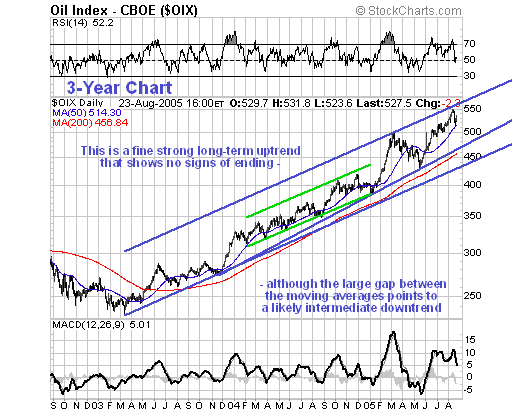 Starting with the 3-year chart for the OIX index we see a fine, strong long-term uptrend that shows no signs of ending, as is the case with the oil chart. About 10 days ago when oil reacted abruptly, the index dropped back sharply, following a close approach to the upper return line of the long-term uptrend channel. However, too much importance should not be ascribed to this upper channel line. This is because the long-term uptrend has accelerated with intermediate reactions terminating at the steeper channel line shown. There is therefore a good chance that the index will go on to break above the current return channel line and accelerate higher. Oil reacted from a channel line and this index has reacted from a close approach to a channel line and, like oil, the 50-day moving average is running way ahead of the 200-day. Like oil the index is not far above its 50-day moving average, and relative to its short-term oscillators is not showing a seriously overbought condition. On the 3-year chart at least, it is likewise difficult to figure the outcome of these contradictory indications and figure an effective strategy. Fortunately the same is not the case with the shorter-term 6-month chart, which is why we are looking at a 6-month timeframe in this update, instead of the 1-year chart used last time round. 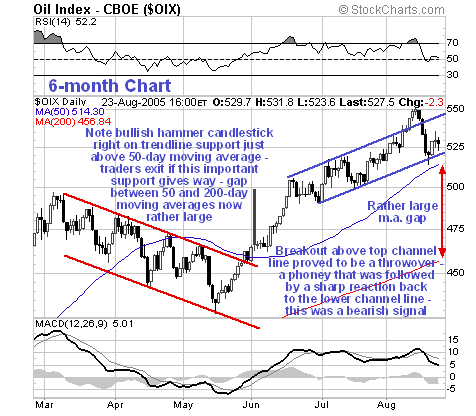 On the 6-month chart for the OIX index we see how the upside breakout from the channel shown about 2 weeks ago turned out to be a throw over, which was soon followed by a rather violent reaction, as oil recoiled from contact with its upper trendline. A reason why those traders long oil stocks at this time need to be very careful is that this kind of violent reaction is frequently a signal of an intermediate trend change. The reaction halted abruptly with the formation of a bullish hammer candlestick just above strong and important support at the lower channel line and not far above the 50-day moving average. Again we have contradictory indications; on the one hand, the throwover breakout and subsequent failure and steep reaction and large gap between the moving averages look bearish, especially as the rally following the sharp decline looks weak and unconvincing and very much like a countertrend flag - if it is we will soon see a plunge. On the other hand, the reaction did not break key channel and moving average support, and a bullish hammer candlestick appeared at the former. How to resolve the dilemma of these conflicting indications? Answer - you don’t have to. Unlike oil itself, the proximity of clearly defined strong support means that traders can simply tighten stops to a position not far beneath the 50-day moving average. Remember not to place stops at “round number” levels either with the index or individual stocks, as this is where they tend to be clustered, allowing market makers to shake people out. Implementation of this strategy means that you are in for prospective future gains, and out quickly in the event that the oil stocks break down.
In the case of the big bullish oil stock that we are following as a barometer for the sector, Conoco Phillips, the long-term chart remains firmly bullish. However, the 6-month chart, while looking otherwise similar to the chart for the OIX oil index, shows heavy volume on the recent sharp retreat, but light volume on the subsequent advance, which is bearish. Traders should exit immediately on a break below $60. 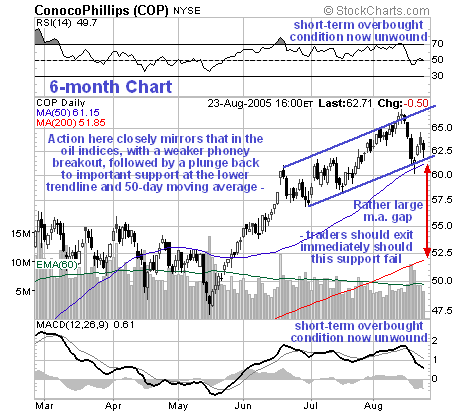 Finally, the latest COT chart looks decidedly bearish for the short-intermediate term - although the Commercials and Large Specs positions are only mildly bearish, the Open Interest level has gone through the roof, which is viewed as a serious warning. 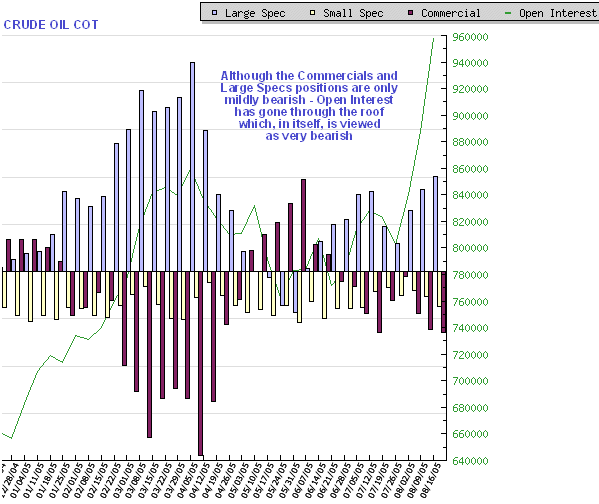 Clive Maund Clive.Maund@t-online.de Clive Maund is an English technical analyst, holding a diploma from the Society of Technical Analysts, Cambridge and living in southern Bavaria, Germany. Visit his subscription website at clivemaund.com .[You can subscribe here]. No responsibility can be accepted for losses that may result as a consequence of trading on the basis of this analysis. Copyright © 2003-2005 CliveMaund. All Rights Reserved. |
| Home :: Archives :: Contact |
MONDAY EDITION June 8th, 2026 © 2026 321energy.com |
|