|
SUNDAY EDITION April 26th, 2026 |
 |
Home :: Archives :: Contact |
 |
Black Gold and U.S. Dollar HegemonyDouglas V. Gnazzo  who controls the energy can control whole continents; who controls money can control the world." [1] Abstract Recently there has been a tremendous amount of discussion in the media concerning peak oil, and other related issues: looming energy shortages, rising oil prices, possible terrorist attacks aimed at disrupting oil flows, and the various negative effects these variables might have on the U.S. dollar: the reserve currency of the world. The following discussion addresses all of the above issues, however, it does not seek to provide any answers or solutions to the tangled web of energy. That colossus of a chore is best left for those with a much greater knowledge on the subject than I possess. Our focus lies elsewhere: upon the U.S. Dollar: see Gold's Hidden Secret: The Moral Hazard of Fiat Money for a detailed definition and discussion of the difference between a dollar and a dollar bill. The remainder of the paper will use the term U.S. dollar for ease of reading, as the term should be U.S. dollar bill, as the two are different, as the above referenced work shows. It is actually this difference, between a paper fiat dollar bill, and a silver dollar coin as defined by the Constitution, that has engendered the sorted details of modern finance and monetary policy you are about to read. The cause of all economic, financial, and monetary problems is the paper fiat debt-money known as Federal Reserve Notes - a despicable transference of wealth mechanism that is bleeding our country dry - and the world. Peak Oil I do not propose to know if peak oil is a given or not, however, it does appear to be a reasonable and valid assumption. There is a vast amount of information that supports the thesis. Obviously, the credibility of the information, as well as those providing the information, is an important concern. Vested interests could easily play into the mix. As one expert states:
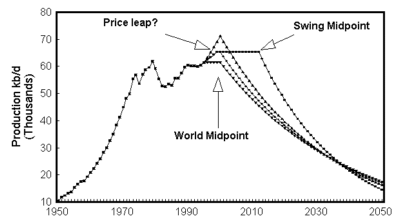 And Life After the Oil Crash Timeline Based on the above and other similar reports by leading authorities, it quickly becomes apparent that we should be very concerned about future energy supplies and prices. A fascinating point to keep in mind is that this scenario was known, and warned of back in 1956, by a geologist named Dr. Marion Hubbert. In 1956, he predicted that U.S. domestic oil production would peak in 1970, and that global production would peak around 1995. He is famous for his chart depicting these peak oil events, which was named Hubbert's Peak: The Energy Curve of History  Life After The Oil Crash What I find puzzling is that both the oil experts and the government knew about these potentially catastrophic world events almost 50 years ago, and yet there has never been any pre-emptive planning put in place to deal with the scenario. It seems like someone has dropped the ball and walked away. Why are the government, and the oil experts, just recently beginning to publicly talk about these problems and issues? This set of circumstances does not pass the smell test. For 50 years, we have heard nothing, and now suddenly we are inundated with books, interviews, articles, radio and TV shows, all kinds of media outlets predicting that the end of the world is fast approaching. Why now and not before? Either the experts are wrong with their peak oil theory, or both they and the government have not been doing their job of informing and protecting We The People. Cui Bono? A viable game plan should be drawn up to deal with the backside of the bell-curve of the supply/demand equation for oil, which appears to be rapidly approaching. Expert estimates vary from the present to 10-15 years out. The longer we put it off - the worse are the possible repercussions. Oil Pricing Others suggest that not only is there a problem with the supply of oil - there is also the problem of a developing negative trend in the pricing of oil: from U.S. dollars to euros. The supposed catalyst for this is the possible Iranian Oil Bourse (IOB) that some predict will start in March 2006.
That is some heavy stuff: suggesting U.S. intervention; U.S. global domination; encroachment on dollar supremacy, etc. In addition, be it noted that by intervention what is meant is war. These are critical and world altering issues, which need to be addressed. New Order It sounds like a new order has begun to be implemented, as if the world is suddenly being tossed into a seething sea of turmoil, disparately grasping for a saving lifeline - not caring who is at the other end of the line, nor how much it costs - even if the cost is the loss of freedom; bondage to debt; and perpetual servitude to the elite money powers that be.
Oil And War Once again, I have no idea if the establishment of an Iranian Oil Bourse would be grounds for an invasion of Iran, just as I have no any idea if the reason Iraq was invaded was for oil, although such reasoning is plausible, and has been suggested:
I am not convinced that the switch from pricing oil in U.S. dollars to euros was the defining issue validating the invasion of Iraq, but stranger things have happened. I do note, however, that Iraq exports approximately 2.9% of the world oil supply, which are not earth moving numbers, nonetheless they still pose a critical and potential problem to be solved. It appears that the dogs of war require more scraps than that, however, before performing their deadly feats. Iran exports approximately 5% of the world oil supply, as the chart below indicates. Might 8 be the magic number? I think not, but I have been wrong before. Production & Consumption 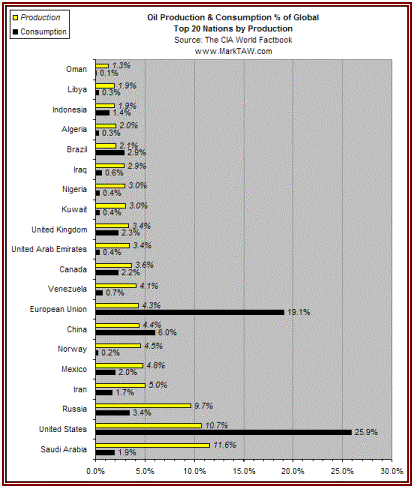 The Petrodollar Emilie Rutledge, a British economist who is currently based at the Gulf Research Center in Dubai has stated:
The Costs So, how much money or dollar bills are we talking about here? The Wall St. Journal reports that:
To date 144 billion has been pledged towards financing the war in Iraq. The billboard in Times Square estimates the total amount spent so far as being over 220 billion: Project Billboard - The Opportunity Costs of the Iraq War - Center ... The World's Gross Product was over 55 trillion dollars in 2004: CIA - The World Factbook -- World. Fifty Five billion dollars just doesn't seem to stack up against $55 trillion. Further along the Petrodollar Warfare article we find:
Now, if there is one thing I am sure of it is that the global oil and gas market is NOT the largest market in the world. The largest market in the world is the foreign exchange market, known as the FOREX market. The Forex Market The FOREX market trades approximately 2 trillion dollars per day, which comes out to over 500 trillion dollars per year. In one day of trade the FOREX market trades more than the entire oil market of Iran does all year. 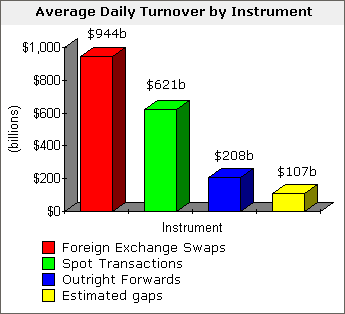 Forex Market Snapshot The US dollar is involved in approximately 90% of all foreign exchange transactions, equivalent to over $1.5 trillion a day. Fifty Five (55) billion a year in Iranian oil sales seems to pale in comparison to almost 500 trillion in worldwide dollar transactions per year. Relatively speaking, it is more of a drop in the bucket than a serious threat to petrodollar hegemony, at least presently - but all things can, and do change, so anything is possible. Moreover, anything can be part of the best-laid plans of mice and men; and many ever-larger drops will fill a bucket. Might the synergy of the several parts to the whole be the real prize being sought after? Feasibility 101 The only way that it is feasible to suggest that war has been initiated over oil would be if the entire Mid-East oil supplies were the intended spoils of conquest; and this presumes that a delusional group of megalomaniacs are playing a real life and death game for ruler of the universe, with a long stop-over in the Mid-East. All under the watchful eye of Lucre, and he under the watchful eye of another. Unfortunately, under the above scenario the drops in the bucket quickly begin to add up. No longer are the dogs of war looking at mere scraps - now they are licking their chops and salivating over 60% of world oil supplies, as the chart below shows. The stakes have been raised. The players are on the field, and more are headed towards the coliseum. 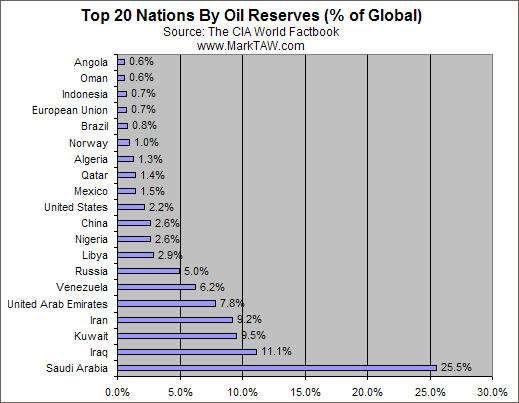 However, much of this is all based on nothing more than conjecture and speculation. Besides, what our present discussion is most interested in is the question of what the possible effects any of this would have on the U.S. Federal Reserve Note - the reserve currency of the world: the U.S. Dollar. Oil For Money For those who haven't read some of my earlier works: The Federal Reserve: Fractional Reserve Lending; The State of Gold: The State of State; Gold's Hidden Secret: The Moral Hazard of Fiat Money - I am not a big fan of any paper fiat currency, let alone the number one transgressor upon the field of many. Keep that thought in mind as we proceed. Let's go straight to the heart of the issue - the monetary pump that keeps the economic world in motion - at least for the present; the future - well, the future will take care of itself, all it needs is a little help - our help - We The People's Help. There are a few things we know for certain: the U.S. dollar is the reserve currency of the world; the FOREX market is the largest market in the world, trading almost 2 trillion dollars daily; the U.S. dollar is involved in 90% of those transactions; and lastly we know that - Debt And Oil As has been shown in Social Security: Nothing But The Truth, Part 2 the present total debt of the United States is approximately 40 trillion dollars. Add to that the 44 trillion dollars of unfunded off-budget debt and: Since the Bretton Woods Agreement, the dollar has been the reserve currency of the world. By royal proclamation, once known as the King's prerogative, all central banks of the world must hold U.S. Dollar reserves equal to their local currency in circulation. The reasons are many: to finance imports; back exports; sustain the exchange value of their domestic currencies; and to protect their currency from speculative attacks - such as George Soros pulled off against the British Pound. There are other reasons as well. By default, U.S. dollar reserves must be invested in US assets - mainly US Treasury debt, euphemistically known as bonds. Reserve Currencies And Oil Actually, the above is one of the main reasons why the Bretton Woods Agreement was force fed to the world in the first place. By having the world's reserve currency, the United States has the rest of the world by the jugular, providing a mechanism that some arguably call the largest extortion racket on the planet. This is one of the causes of our current trade deficit, and our capital account surplus. The U.S. gets to create all the paper fiat debt-money it desires, and then it gets to exchange the paper for real goods and services we receive from our trading partners. The U.S. has become an exporter of debt. Our number one product is paper, especially paper fiat - created by decree. She Who Dares Sell The Future - For The Vanity Of The Present The Whore Of Babylon Lusts After All - And Knows No Peace Woe To Her And Her Wicked Ways Of Wantonness Our foreign trade partners have to do something with all the dollars they receive from us, so they turn around and invest the dollars in U.S. Securities, mainly Treasury debt obligations known as bonds - promises to pay, not payment - promises to pay. Global Investing But it gets worse, if that's possible. The net international investment position of the United States is minus -3 Trillion dollars. That is equal to approximately 25% of our GDP. This begs the question: In today's electronic world of fast paced communication, the dollars never even have to leave New York - the transactions of double-entry bookkeeping are done almost instanteously. Welcome to the new order. Presently U.S. dollar reserves are approximately 70% of total world reserves. The euro comprises approximately 15%. Thus, the world is literally awash in U.S. dollars, creating what many rightfully call dollar hegemony. Divine Right The self-appointed divine right of being the world's reserve currency has brought/bought with it many perks, one of the most powerful being that all strategic commodities are priced, bought, and sold - only in U.S. dollars. It is somewhat analogous to having the special mark of birthright. Or perhaps you have been to Sin City and the Casinos - The House of The Rising Sun. They all have distinct and individual chips with their own unique mark on them, which means they can be cashed in at that casino, because of their mark - of possession. Free Oil There are those who say that such an arrangement amounts to getting oil for free. Others claim that because the price of oil has recently been high that the demand for oil increases, which in turn increases the demand for dollars, which in turn allows the Fed to create (they don't print them anymore in the brave new world of computers) excessive amounts, and the best part - without driving the value of the dollar down. I will be the first to state that I believe that U.S. dollar hegemony is a bad thing, which it indeed it is. However, to say that we are getting our oil for free is a bit of a stretch. There is a lot of physical labor that goes into harvesting black gold from the bowels of the earth. Men are killed in the process; men are blinded and crippled for life doing the intensive labor required. Babies grow up without fathers. It is a very tough job. If it is true that we are getting our oil for free, then it is also true that we are getting anything and everything we buy with U.S. dollars for free. Likewise, all currencies in the world are paper fiat, the same as the dollar, so the same holds true for them. Does this mean that whenever others buy anything with their fiat currencies, that those items are being bought for free? It would appear that everything in the world is being bought for free. Can this possibly be? In Theory - Where's Realty I understand the theoretical concept behind such statements, but I will defer to the precise clarification from the writers if they are so inclined to indulge. Nevertheless, theory is one thing; actual experience or realty is another - even if it is a horrid con game of illusion and delusion. It appears that the thinking is: because the U.S. can print dollars at will, it doesn't cost anything to create ever more dollars, and hence they are obtained freely. Consequently, when we use the dollars to buy oil, we are getting the oil for free, because the dollars used to purchase it were free. Furthermore, if the oil is free because the dollars were free - then everything purchased with dollars, and for that matter - any paper fiat, is free as well. Not quite, but it was a good try. Labor - The Energy Of Life It is true that it does not literally cost anything for Sir Alan to click away at his computer and suddenly increase the money supply by $50 billion dollar bills. Likewise, it is true that the literal cost is negligible for the Treasury to create more bonds or debt. However, where is the American worker in all this? Do we not go to work every day, and in return for our labor do we not accept U.S. dollar bills? And why do we offer our individual energy, harnessed and concentrated as labor, in return for dollar bills? We do it because we have to, out of the necessity to provide for our families, to obtain the basic needs of life: food, clothing, shelter, etc. Moreover, we accept U.S. dollars because we are not aware that we have a choice, such is the illusion of legal tender laws in paper fiat land. However, we do have a choice - its name is Honest Money. Therefore, although U.S. dollars have no intrinsic value, just as Treasury bonds have none - that does not mean that millions of men and women have not traded their life's work for a goodly proportion of those dollars. Behind the dollars stand the labor of man, and behind the labor of man stand goods produced and brought to market. To say that U.S. dollars have no inherent or intrinsic value is true. To say that all the hard work that men and women do to produce that which is traded for dollars also has no value is an entirely different matter - and it is wrong to say it has no value. Likewise, to say that any given commodity, be it oil or butter, is obtained for free because dollars are used to purchase it, is wrong as well. Nothing is free - never has been, never will be - because it cannot be, except for the ultimate "thing." What is free is not the oil, not the wheat, not any of the commodities - what is gotten for free is the ultimate form of energy: man's servitude to the almighty dollar, and those who wield it over his head as the Sword of Damocles. By accepting the unacceptable, the abomination known as paper fiat debt-money, we allow our labor and personal energy to be exchanged for paper that is not actual payment in kind, but a promise to pay - later, in the future. The future is being sold for the present. By What Cost What is had for free is the wealth transference that takes place when debt circulates as the currency - the wealth transference that the few elite overlords of the monetary system usurp from the millions of unwary hosts - We The People. So do not say there is no cost - for the cost is greater than you know. How much is the cost of one's soul? Therein lies the answer. Because the U.S. dollar is the fiat reserve currency of the world, the Fed gets to create excessive amounts of currency; it revels in pure wantonness that knows no bounds. Nevertheless, do not confuse the crime with he who commits the crime, or with the intent behind the crime. Each has and plays a different role. Learn the script, play, actors, and stage - before it comes to a theatre near you. Pure Speculation Another article purports the following concerning oil and the U.S. Dollar:
The several issues raised in the above quote contain this paper's main topics of discussion. Financial and monetary concerns are foremost in importance, and will be our focal point. We are going to examine the paragraph line by line, to better discern exactly what is being said, and what is meant. All quoted material will be in dark blue type and indented. Comments will be in black type and not indented. Please note that we are only using this quote because it provides a great deal of important questions and issues regarding the oil markets, the FOREX markets, and especially the exchange between the U.S. dollar and the euro. We are interested in what the article says, not who said it, as there presently are myriads of writers saying essentially the same thing. A Closer Look
The author answers his own question in the next two lines that follow. Basically he says that the dollars are not going to be of much help to you, as the oil is being sold for euros and you have dollars. The obvious remedy is to sell your dollars for euros. We agree.
It is true that whenever anything is sold en mass that its value drops - (IF??) the demand for what is being sold does not increase; and if all other factors remain constant, which is not usually how things work. The world is in a constant state of flux, forever moving and changing. In the context that it is being used, value equates to price. There is much more to all this than meets the eye, however, we will wait for further statements before adding any further comments. The goal in mind is to more easily faciliate bringing together the component parts of the thesis being developed, thereby providing a more coherent and understandable finished product.
By "this means less demand for Dollars," we take what is meant is the above reference that the selling en masse of anything lowers its value, hence the en masse selling of dollars for oil is being said to cause less demand in the future, or after the en masse selling takes place. Simply because things are sold en masse it does not directly follow that their demand goes down - the specific case being discussed is that the selling of dollars would cause less demand for dollars. Now, perhaps what was meant by demand, was strictly the demand for dollars with which to buy oil from Iran with, and only oil which also suddenly changes to being denominated into euros. As was shown in the beginning of this paper, the amount of oil that Iran sells is 5% of the world's total oil supply - a number of approximately $55 billion dollars worth. This amount of oil pales in comparison to the rest of the world oil market, pales even more when compared to the gross product of the world ($55 trillion), and is completely dwarfed by FOREX trading ($500 trillion yearly). An important point in all this is the actual amounts of both oil and dollars that are directly involved in the proposed Iranian Oil Bourse. According to any credible major oil supply data, Iran accounts for selling at most - $55 billion dollars of oil yearly - none of which is sold to the U.S. Fifty Five billion dollars of oil does not equate to "en masse" when properly compared to other market sizes, shares of market size by currencies, shares of market size per nation, nor the increase in demand for all other commodities purchased with U.S. dollars - all of which combined have a much greater effect upon demand and supply determinations. The proverbial spit in the bucket does affect the amount in the bucket, but when compared to someone pouring in a cup of coffee, or the combined "spits" of several other suppliers, the lone spit takes on less and less meaning, and has less and less overall effect.
It would be interesting to know exactly what is meant by excessive amounts of dollars, as many, myself included, would say that excessive amounts of dollar creation has already occurred in extremis. This can be seen by the loss of 95% of the U.S. dollar's purchasing power since 1913. Make no doubt about it - the Fed will print more excessive amounts of dollars, it has no choice - it's either inflate or die. There are only two paths that cross the desolate terrain of paper fiat land: deflation or hyperinflation; and one or the other will be traveled. Perhaps we should be concerned with the peak dollar issue, as well as that of peak oil. To be so focused on the mere possibility that an Iranian Oil Bourse may, in the future, price what presently amounts to 5% of world oil supply, valued at $55 billion dollars, into euros - seems a bit extreme to say the least. Unless of course there are other underlying facts or orders for such that we are not privy to. Once again, it would be interesting to know what is meant by "too much supply?" It couldn't possibly be the $55 billion dollars worth of oil that Iran produces, as that is a mere drop in the bucket of the tricks of prestidigation that our wizards of finance can conjure up.
To say that "lately it has taken more dollars to buy oil" is without question correct. To say "so the demand for Dollars has been up" is also true, if what is meant is a demand for dollars with which to buy oil. The demand/supply of dollar for oil is a separate and much smaller part of the demand/supply for dollars for all goods and services in the world. We will graciously accept as a given that the Fed can print all the dollars they want because the demand for dollars has been on the rise due to rising prices for oil. We also offer the following chart that shows the most recent price trend: 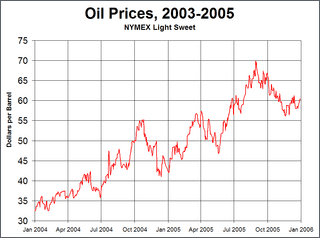 Where is the logic that gets us from the statement that the fed can print all the dollars it wants, because the demand for dollars has been up, due to the fact the price of oil has been up - to the proposition that an Iranian Oil Bourse, and its selling of $55 billion dollars worth of oil for euros instead of dollars, is going to have a world altering impact on the foreign exchange value of the dollar? No account of all the other supply and demand relationships between all other world goods and services that are purchased with U.S. dollars have even been mentioned, let alone put into the equation of "the Fed being able to print all the dollars they want because the demand for dollars has been on the rise." There is no way that a $55 billion dollar or euro market in Iranian Oil pricing is going to change the amount of U.S. dollars that central bankers hold on reserve; nor what percent of euros they hold on reserve; nor what other debt instruments they hold on reserve. Knowing the size of the entire flood of dollars and dollar denominated debt present in the world today, there is no way that any central bank is going to cut their own throat by selling dollars en masse, as they would be destroying what little remaining value of all the dollar denomated debt they presently own. Furthermore, the dollar's exchange rate is not going to be determined by the loss or gain of $55 billion dollars worth of market share because of what currency Iran chooses to sell its oil in.
This is a puzzling statement, and seems to contradict the earlier statement that selling anything en masse lowers its value. How on the one hand, can $55 billion dollars worth of oil, be it in dollars or euros, affect a large enough en masse selling to cause the value of the dollar to drop; while on the other hand it is stated that this extra demand for oil and hence dollars has allowed the Fed to print all it feels like with little consequence? When anything is purchased with dollars - dollars are sold by one party, and bought by the other party. All things being equal (which they rarely are), when the total dollar supply increases proportional to the total demand for them, then the value or purchasing power of the dollar does go down. This is why the purchasing power or value of the dollar has been decimated by the Federal Reserve's relentless creation of ever larger doses of paper debt-money. They have created an extremely excessive supply of dollars, as compared to the demand for those dollars to purchase goods and services with, resulting in a 95% loss of purchasing power since the Fed took control in 1913. To say that the Fed has been able to do this with little consequence is quite the understatement - to say the least. The consequence is why we as individuals, and why we as a nation - have become mired in debt, bound in servitude to work towards the futile attempt to service, let alone pay, the public debt. But not to worry, we only owe it to ourselves. Yeah right. The reason why our net international investment position is a huge -3 trillion dollars; why our savings rate is miniscule; and why our debt levels are so extreme - all revert back to the debasement and destruction of the purchasing power of our currency, and the pathetic job the Federal Reserve has done in protecting our well being. They have allowed our wealth to be siphoned off in a wealth transference scheme that borders on mass extortion. Little consequnce - I think not. Stick around for the day of reckoning - the weighing in the balance, it ought to win the academy award of the present cosmic cycle of evolution and involution for the greatest performance known to man or beast. For some reason I don't think the beasties are going to like being found to be wanting, let alone the washing in that lake. Just what was the Dead Sea before it got dead - the old order? Exchange Rates And Oil Changes in the exchange rate of the U.S. dollar can affect world oil demand, as well as the world price of oil. The reason is because oil is both priced, sold, and paid for with dollars. The last few years have seen the dollar decline by approximately 20%. The decline has not been the same with all currencies. Some move up, some move down, some do not budge. The predominant change has been against the euro. Because of this change, many are calling for the euro to challenge the dollar for world reserve status; if not directly then indirectly, as in a two-tiered world reserve currency system, somewhat analogous to the two-tiered gold standard that once was. Many of our Asian trading partners intervene in the currency markets to prevent the dollar from declining in value relative to their currencies, most notably Japan. Because China maintains a fixed exchange rate with the dollar, the yuan has not appreciated against the dollar. So, just how do changes in the exchange rate of the dollar in the foreign currency markets affect the oil markets? Furthermore, is this a one-way street, or does the oil market also effect exchange rates? The answers are not a simple yes or no. The effect of exchange rates upon the oil market has many different variables and inter-dependent relationships that play out differently, each creating a complex matrix of cause and effect. Then throw into the mix that the above possible scenarios have different effects based on whether the currency of the country in question, is a net exporter or importer of oil. Also of importance is exactly what exchange rate changes have taken place against the dollar, and how the currency and trading policies of the country in question have adjusted to such changes. Let's say the value of the dollar declines against certain currencies of oil exporting nations. This means the dollars they receive in exchange for their oil are worth less in terms of purchasing power. If dominant oil exporters are able to set the price of oil, and if market conditions allow them to dictate higher prices, they will take advantage of the opportunity to raise the price of oil in dollar terms, to make up for any purchasing power loss due to falling dollar exchange rates. This is just what Saudi Arabia did back in the 70's oil crisis. Because they had finally figured out how bad they were getting ripped off by accepting paper fiat U.S. dollars, which were continually losing purchasing power, the not so dumb oilmen realized they needed to get more dollars (quantity) for the same size barrel of oil. The chart below illustrates the point: 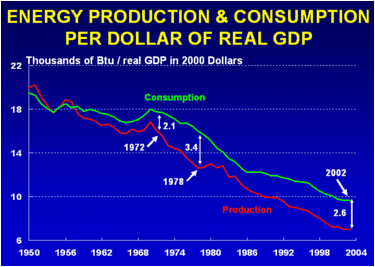 In paper fiat land, the debasement and quality loss of the currency is always trying to be made up for by ever-larger quantities of money. It is similar to the futility of a hamster running around on his little flywheel - he just doesn't get anywhere. It can't be done. The Euro And The Dollar As previously stated, the euro has appreciated against the dollar. This means it takes more dollars to exchange for the same amount of euros. If the price of oil, as denominated in dollars goes up, any such increase is offset by the commensurate rise in the euro exchange rate against the dollar. This means that the demand for oil in the euro area is less likely to be affected by high oil prices as long as the euro appreciates against the dollar. Japan, Korea and Taiwan often intervene in the currency markets to keep the dollar from falling relative to their own currency. They do this to preserve the export advantage a lower exchange rate affords. It is more important to them to protect their economic trade levels, than to collect on benefits an appreciating currency would have on their oil imports. This is why China wants to maintain a fixed exchange rate against the U.S. Dollar, in order to protect and support their export trade. They too are not so stupid. They too are questioning the established order. Some economists believe that an appreciating currency raises the cost of that nation's exports on the world market. This cost increase reduces their sales, and if the reduction in sales is large enough, it might reduce the GDP growth of the nation with the appreciating currency. Under 3 Different Price Scenarios 
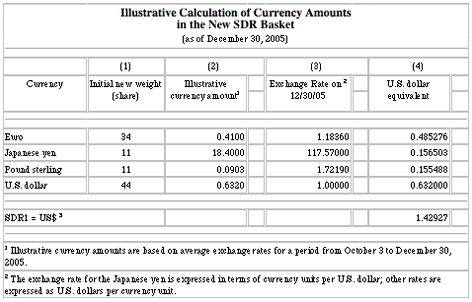
It appears that in today's new order that exchange rates have more of an effect on oil, than oil has on exchange rates. All exchange rates are based on the dollar. The dollar represents approximately 70% of all central bank reserves. Even the new world's currency of SDR's is dominated by the U.S. dollar. The largest accumulation of debt in the world is denominated in U.S. dollars. Thus, it is easy to see that the U.S. dollar remains the alpha male until such time as it does not, which granted, may be fast approaching, but not because of any Iranian Oil Bourse. The following is from the International Monetary Fund's Website:
The footnotes can often times be more telling than the main body in such reports. Who Has The Power Petrodollar Warfare: Dollars, Euros and the Upcoming Iranian Oil Bourse mention the two main existing markets for the trading of oil:
The following is from the London International Petroleum Exchange's website:
The last line is most telling with its description that over $2 billlion daily worth of contracts are traded on the IPE - recall that Iran's yearly revenue for all their oil is $55 billion. Also, if one checks out who owns the consortium, you will find that it is the elite money powers of the second and third ring emanating out from the inner source. Even more fascinating is what a Congressional Report on world oil demand and its effects on prices has to say regarding the two well established trading platforms referenced above:
In the aftermath of Katrina natural gas prices were said to be headed for the moon. Every reason in the world was pontifiicated upon as to why there would be massive shortages this winter and skyrocketing prices for both natural gas and oil. Suddenly in November of 2005, the Federal Reserve gave its Approval of proposal by JP Morgan Chase & Company (click link for Fed Document of approval) "for commodity trading activities, including physical transactions in energy-related ... JPM Chase also must notify the Federal Reserve Bank of New York..." Even more sudden was the 40% drop in natural gas prices. 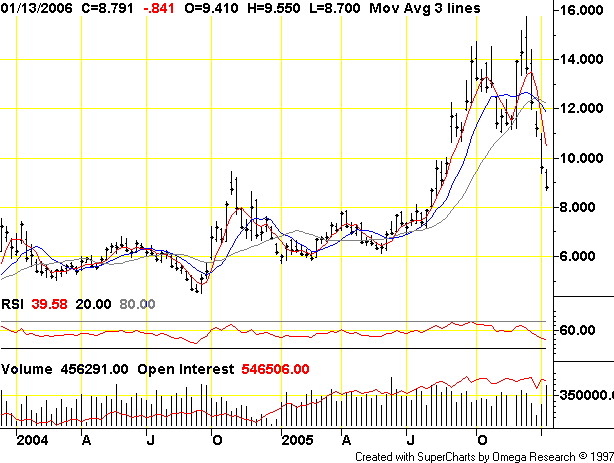 Further along in the Petrodollar Warfare article we read:
Therefore, not only do we have Iran out to destroy the dollar, now the central banks of the world are moving together in lockstep to "cripple the U.S. dollar and economy". The reason being is to stop any unilateral war and its destructive effects on oil supply. The above is a distinct possibility, although a remote one. First, a number of assumptions are being made: all industrialized nations see eye to eye on the issue; all industrialized nations will cooperate in concert against the largest military power in the world; all industrialized nations and their central banks are opposed to unilateral war; and most importantly - that it is the Nation States of the world that are calling the shots in the race for ruler of the universe. Perhaps such a scenario is likely, then again perhaps not. The biggest question is the last: whether the Nation States are calling the shots. Does history support such belief in the power of the State, or has history been witness to the nations of the world being steered into certain courses of action for the benefit of those doing the steering? Cui Bono? Benjamin Disraeli, first Prime Minister of England stated in 1844:
Who might Disraeli have been referring to? He was a powerful man in a powerful position, yet he refers to others behind the scenes as being the ruling force of the world. Georgetown professor Dr. Carroll Quigley wrote about the goals of the international elites who control governments and central banks in order to create A New World Order:
Many consider the President of the United States to be the most powerful person on earth, and perhaps rightfully so. Here is what President Woodrow Wilson had to say on the matter:
Conclusions There is the distinct possibility that the often talked of "powers that be" are not the individuals that most consider them to be. They are not Presidents of Nations, although they may do their bidding. They are not Kings and Queens, although they may do their bidding. They are not the mightiest military powers, although they may do their bidding. They are so subtle and powerful that they often support both sides in international disagreements, waiting to the last second to remove their support from one side - tipping the balance of power. They are so powerful they created the concept and working structure of central banking. If money is truly the sinew of war - then he who controls the money, controls war, and the outcome of war. Are there those who profit from war - the merchants of death? So perhaps we should not be so quick to believe everything we read, as who owns most if not all of the major media outlets. Perhaps the Iranian Bourse will come to be. Perhaps it will have an affect on the value of the dollar - perhaps not. Might there be those who would like to see the U.S. dollar collapse? Might there be those powerful enough to set up the Iranian Bourse or anyone else they care to, to take the fall? Did we not just read a very highly regard paper on Petrodollar Warfare that talked of such. Furthermore, what of the euro - has it just happened upon the world stage without a lot of forethought and planning? Who was the force and power behind all that planning, and what fore? Could the euro and euro-land be a prototype of a New World Order? Why has Britain been so reluctant to join? Who resides in the innermost circle? Cui Bono. Nevertheless, one thing is almost certain - nothing will happen that is not directed to happen - by the board of directors of the New World Order. that shall not be revealed; and hid, that shall not be known." Letter To Congress Coming The First Week of March 2006 "Fear them not therefore; for there is nothing covered, that shall not be revealed; and hid, that shall not be known." Jesus (Mat. 10:26) _____________ [1] Henry Kissinger ©2004-2006 Douglas V. Gnazzo. All rights reserved. Douglas V. Gnazzo is CEO of New England Renovation LLC, a historical restoration contractor that specializes in restoring older buildings that are vintage historic landmarks. He writes for numerous websites and his work appears both here and abroad. Just recently he was honored by being chosen as a Foundation Scholar for the Foundation of Monetary Education (FAME). Disclaimer: The contents of this article represent the opinions of Douglas V. Gnazzo. Nothing contained herein is intended as investment advice or recommendations for specific investment decisions, and you should not rely on it as such. Douglas V. Gnazzo is not a registered investment advisor. Information and analysis above are derived from sources and using methods believed to be reliable, but Douglas. V. Gnazzo cannot accept responsibility for any trading losses you may incur as a result of your reliance on this analysis and will not be held liable for the consequence of reliance upon any opinion or statement contained herein or any omission. Individuals should consult with their broker and personal financial advisors before engaging in any trading activities. Do your own due diligence regarding personal investment decisions. This article may contain information that is confidential and/or protected by law. The purpose of this article is intended to be used as an educational discussion of the issues involved. Douglas V. Gnazzo is not a lawyer or a legal scholar. Information and analysis derived from the quoted sources are believed to be reliable and are offered in good faith. Only a highly trained and certified and registered legal professional should be regarded as an authority on the issues involved; and all those seeking such an authoritative opinion should do their own due diligence and seek out the advice of a legal professional. Lastly Douglas V. Gnazzo believes that The United States of America is the greatest country on Earth, but that it can yet become greater. This article is written to help facilitate that greater becoming. God Bless America. |
| Home :: Archives :: Contact |
SUNDAY EDITION April 26th, 2026 © 2026 321energy.com |
|